
The Same 3 Failures That Sank ERP Can Sink Your AI Agents (Part 1 of 2)
AI can accelerate core processes — but the same structural failures that sank ERP implementations for 3 decades still apply.

Everyone is excited about AI agents and “Mini-ERP” builds, especially SMEs and start-ups that cannot afford millions of dollars and 12–24 months for traditional ERP implementations. AI Agents are faster and more accessible than ever. That excitement is justified — yet it is also incomplete.
Three decades ago, Dr. Michael Hammer (MIT) wrote in Reengineering the Corporation that real performance lives in a few end-to-end core processes, not in departmental silos. I was privileged to work with Dr. Hammer in 2000 when he led the implementation of Process-Based Management while I was Director of Strategic Supply Chain at a Fortune 500 aircraft OEM. His insight still holds true. Three of the most important core processes remain:
Lead-to-Close (or Quote-to-Cash)
Order-to-Ship (includes all of manufacturing, assembly & test)
Procure-to-Pay
These processes continue to cut across silos. They are still where resilience, cost, speed and quality are won or lost. AI agents can map them, streamline them, and even execute parts of them far faster than the reengineering teams of the 1990s. But AI cannot compensate for the same three structural failures that have sunk large software projects for 3 decades:
Big Bang implementation instead of Pilot + Phased rollout
Dirty data that was never cleaned up-front
No full-time PM or dedicated team
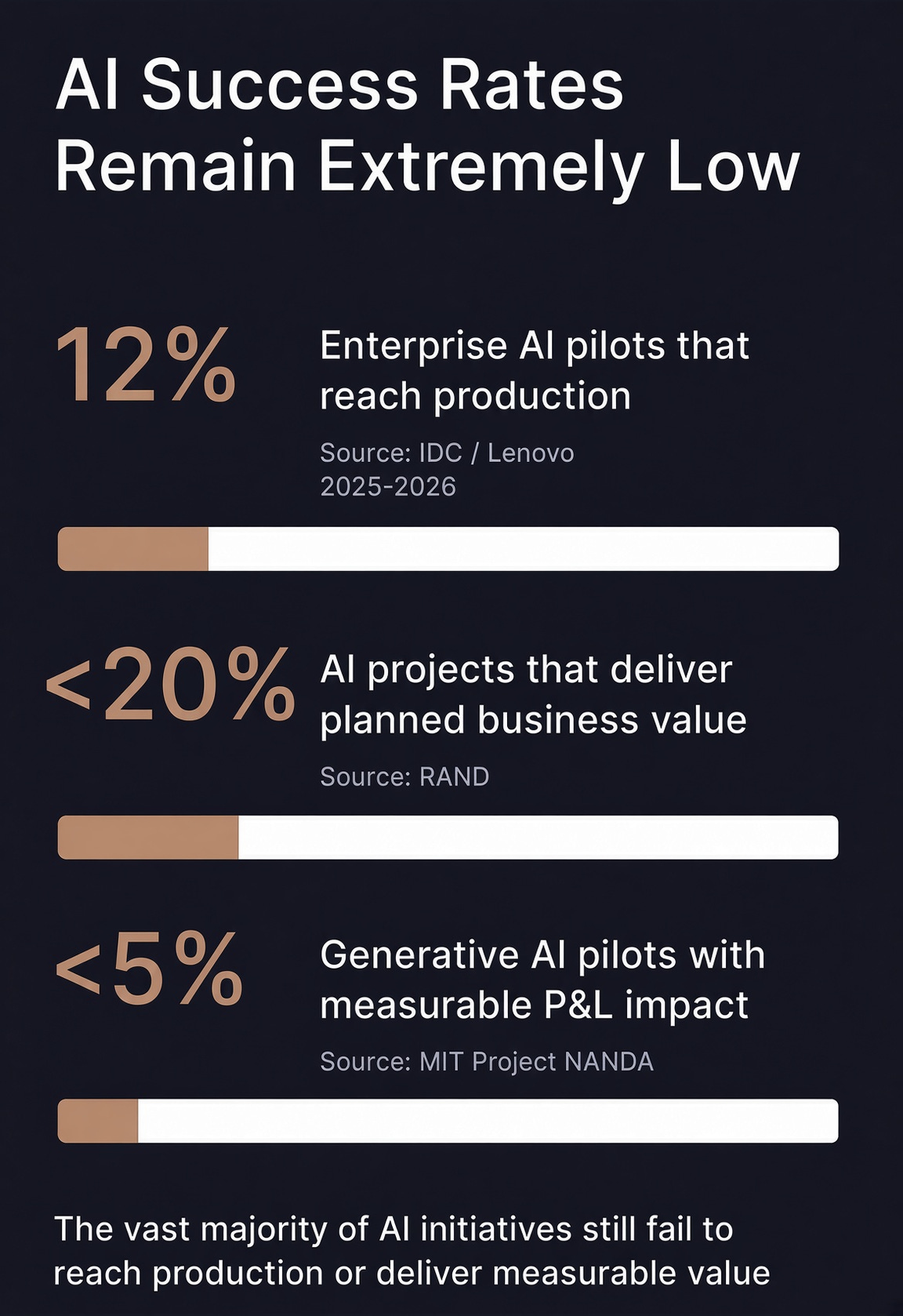
Historical data is unchanged: 55–75% of ERP projects still fail to meet their original objectives. AI pilot-to-production failure rates are at least as high — in fact, multiple 2025–2026 studies put the figure between 70% and 88%. The root causes have not changed.
Conclusion: The root causes of these failures have not changed – even when AI is introduced.
What to do about it?
Before you commission the first AI agent or Mini-ERP module, answer three questions:
Which of the three core processes creates the most value (or the most risk) for your business right now?
Is the data in that process clean enough that an AI agent would trust it?
Who will own the process full-time once the pilot ends?
In Part 2 we will examine each of the three failures in detail — and demonstrate where AI agents can actually help versus where it still requires disciplined human governance.
CTA: AI will not save a broken process or dirty data. It will only make the consequences arrive faster. Which of the three classic failures is most active in your organization today?